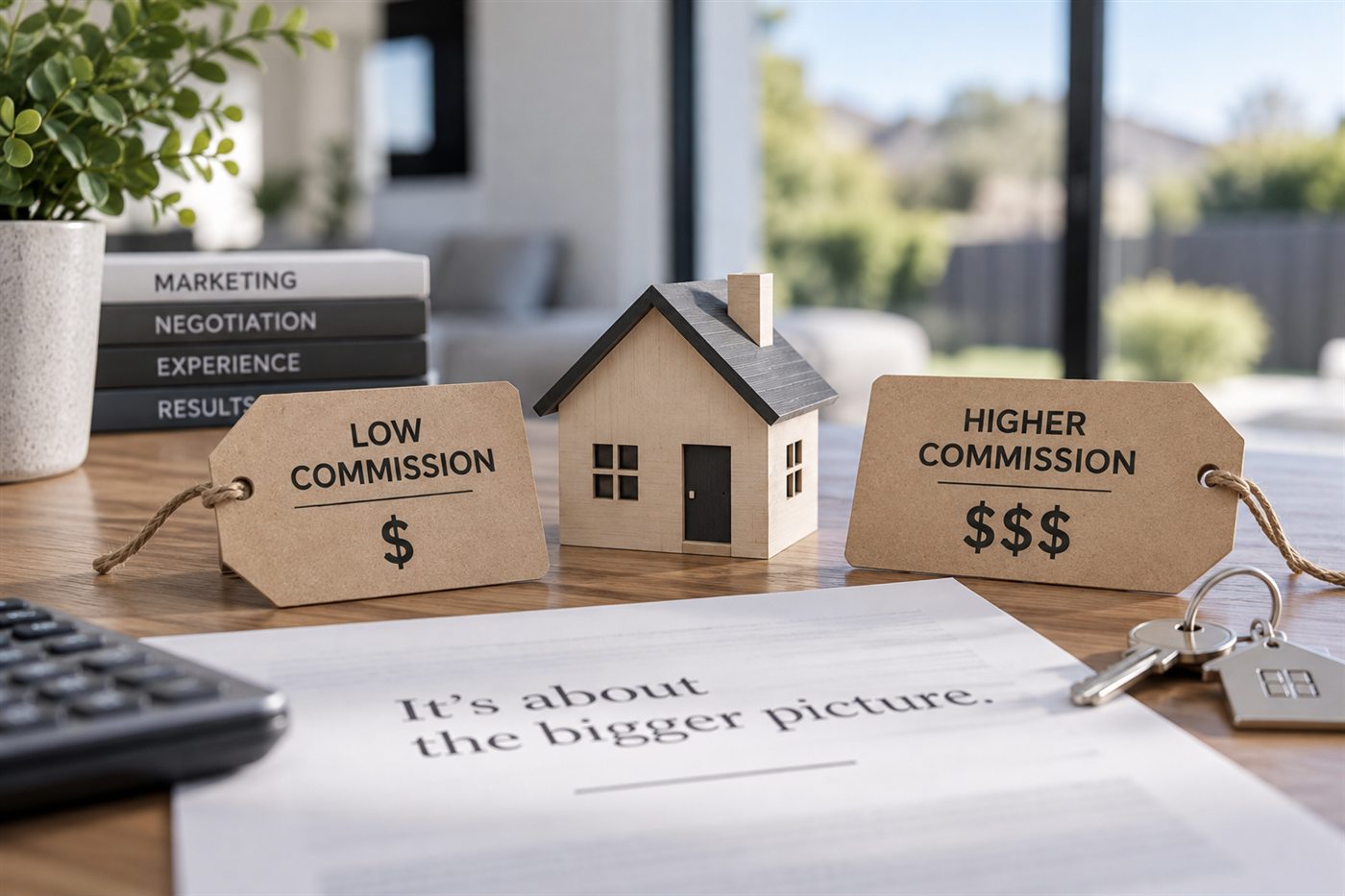
When you're choosing an agent, the commission is often the first number you see, and it's natural to want to pay less. A lower fee can be a good thing. But the fee is only one part of the picture, and the lowest quote isn't automatically the best result.
Look at what you keep, not just what you pay
What really matters is the amount left in your pocket at the end: the sale price, minus commission, marketing and other costs. A small difference in fee can easily be outweighed by a small difference in price.
Here's a simple example, for illustration only. On a home that sells for $600,000, a 0.5% difference in commission is $3,000. A 1% difference in the sale price is $6,000. So the question isn't only 'what will you charge?' but also 'what will you do to help me get the best price and a smooth sale?' These figures are an example, not a promise of any result.
What commission usually pays for
- Pricing advice based on recent local sales
- Marketing, including photography, online listings and advertising
- Open homes, private viewings and following up buyers
- Negotiating offers and managing conditions
- Looking after the sale through to settlement, and keeping you informed
Questions to ask about any fee
- What exactly is included, and what costs extra, such as photography, advertising or signage?
- Is GST included in the figure you've quoted?
- How long is the agency agreement, and how can it end?
- What is the marketing plan for my home?
- Who will I deal with day to day?
- How did you arrive at the price you've suggested?
- What happens if the home doesn't sell?
Check you're comparing like with like
A lower fee can work well for some sellers. The thing to check is that it doesn't come with less of what helps a home sell well, such as strong marketing, good communication or support when negotiations get tricky. Two quotes that look different may include quite different things.
Why competition can matter more than the fee
One of the biggest things that can lift a sale price is more than one buyer wanting the same home. When buyers are competing, they tend to stretch further, and to hold back less, than when a single buyer is negotiating alone. It's never guaranteed, and it depends on the home, the price and the market. But it's a big part of why reach matters.
Does agency size make a difference?
In general, the more of the right buyers who see your home, the better the chance of competing interest. That's where the size of an agency can come into it.
- A larger agency often has more salespeople, each with buyers of their own looking, plus an established brand and marketing behind it. More people hearing about your home can mean a better chance of more than one buyer being interested.
- A smaller agency or a salesperson working on their own may have fewer buyers on their books, but a well-run campaign can still reach plenty of people, and you may get more of their personal attention.
- Size on its own doesn't decide the result. What counts is how many of the right buyers actually see your home, and how well your agent brings them together.
Questions about competing offers
Whatever the size of the agency, it's worth asking how they'd create competition for your home and how they'd handle it when it happens.
- How will you reach buyers beyond your own list or agency?
- How will you encourage more than one buyer to compete, for example through the sale method?
- How will competing offers be presented to me, and will I see every one?
- If another salesperson at the agency has a buyer interested, how do you make sure my interests come first?
A good agent should be able to answer these openly. There are rules about how licensed salespeople must act, including being open about any conflict of interest, so ask if anything isn't clear. You're paying for the service, and you're entitled to feel comfortable that your sale is handled fairly.
The same goes for the price
A low fee isn't the only headline number to be careful with. An agent who quotes the highest appraisal isn't necessarily the best one either. Ask each agent to explain their reasoning, using recent comparable sales.
Talk about fees openly
Commission is worth discussing plainly. A good agent will explain it clearly and be comfortable with your questions. Be wary of anyone who is vague about it, or of a headline figure that doesn't add up once the extras are included.
Quick tip
Get the fee, what's included and the marketing plan in writing, and compare them side by side before you sign anything.
If you'd like to see how I'd approach selling your home, including what's covered and how I'd price it, a free appraisal is a good place to start.
This is general information only, not legal, financial or building advice. Rules and market conditions change, so check the details with your lawyer, lender or the relevant authority before making decisions.