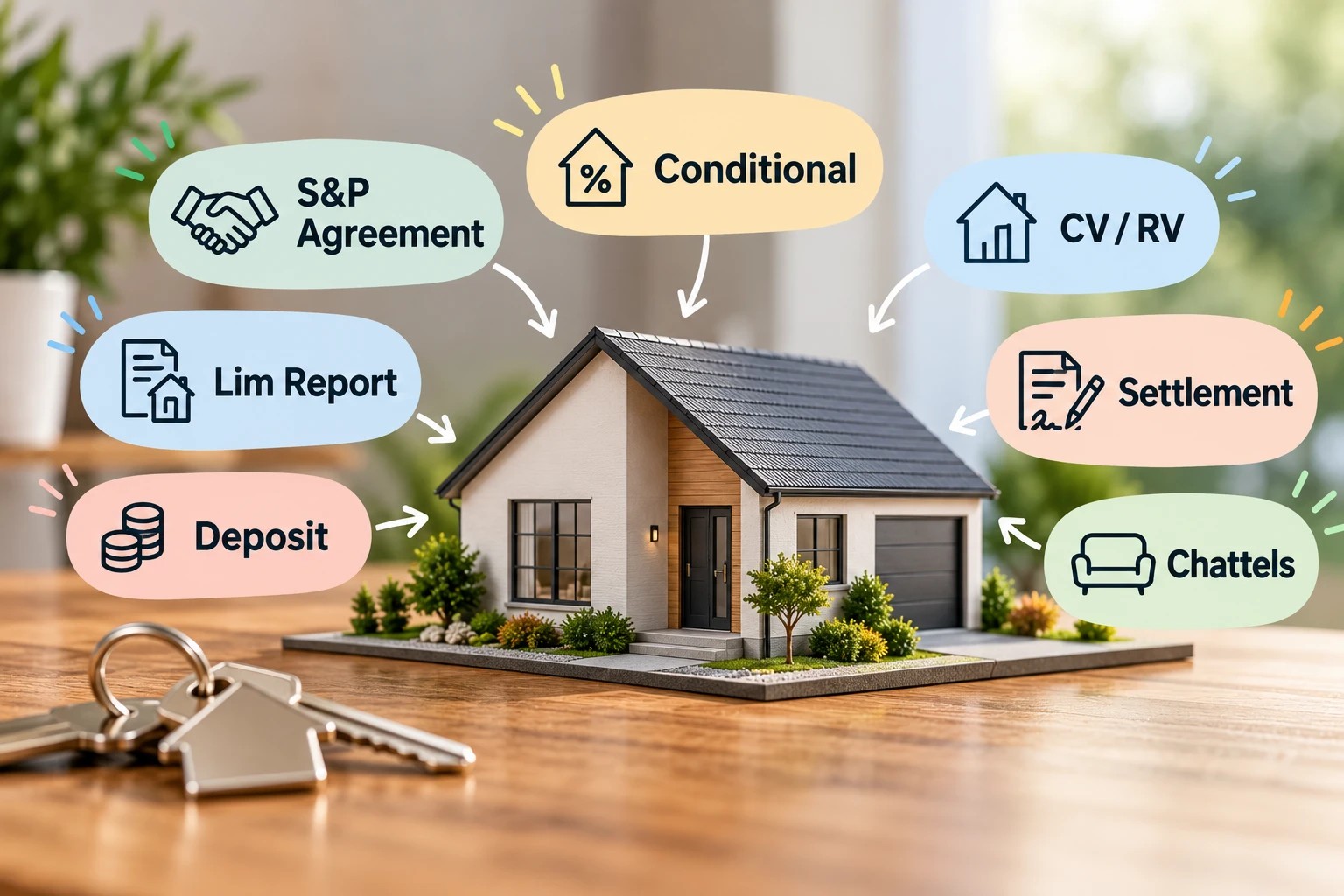
Real estate has its own language, and it's easy to nod along in a conversation without actually knowing what half the terms mean. Here's what the common ones actually mean, in plain English.
Money and ownership
CV / RV (Capital Value / Rateable Value). The council's valuation, used to calculate rates. It's a useful reference point, but it's not the same as what a property will actually sell for — market value moves with demand and can sit well above or below CV.
Deposit. The portion of the purchase price paid when an agreement goes unconditional, usually held by an agency or lawyer's trust account until settlement.
Settlement date. The day ownership and the balance of the money actually change hands. This is different from the date you sign the agreement.
Vendor / Purchaser. The seller and the buyer, in the formal language used on the paperwork.
Registered valuation. An independent valuation from a registered valuer, based on a physical inspection. Unlike the council's CV, it reflects current market conditions and is often required by lenders.
The paperwork
Sale and purchase agreement. The legal contract between buyer and seller. Conditions, price, settlement date and chattels are all set out here.
Conditional / unconditional. An offer with conditions (like finance or a building report) isn't binding until those conditions are met, or "satisfied." Once every condition is satisfied, the agreement becomes unconditional and both parties are committed.
LIM report. A report from the council covering consents, rates, drainage, hazards and other property information they hold on file. A building report is a separate, independent inspection of the property's physical condition, arranged by the buyer.
Agency agreement. The contract between a seller and their agent, setting out how the property will be marketed and sold, and what the agent is authorised to do.
Multi-offer situation. When more than one buyer has offers in on the same property at the same time. Each buyer is usually asked to submit their best offer by a set deadline, without seeing what anyone else has offered.
Vacant possession. A condition confirming the property will be empty, with the previous owner's belongings and tenants gone, by settlement.
Quick tip
CV and market value are not the same thing, and I get asked about this constantly. Don't set your price expectations off the CV alone — ask for recent comparable sales instead.
The property itself
Freehold. You own the land and the building outright. The most straightforward form of ownership.
Cross-lease. You own a share of the underlying land jointly with other owners on the same title, and lease your specific unit from that joint ownership. Changes to your property can require the other owners' sign-off.
Unit title. Common in townhouses and apartments — you own your unit outright and share ownership of common areas via a body corporate.
Body corporate. The group of unit owners responsible for managing and funding shared areas and services on a unit title property, such as driveways, gardens or a shared roof.
Title / Certificate of title. The legal record of who owns a property, held electronically by Land Information New Zealand (LINZ). It also shows anything registered against the property, like easements or covenants.
Easement. A legal right for someone (often a neighbour or a utility company) to use part of a property for a specific purpose, such as a shared driveway or buried pipes. It stays with the land even when it's sold.
Chattels. Items included in the sale beyond the house itself — think stove, fixed floor coverings, drapes, heat pump. Worth checking exactly what's listed before you get attached to that dishwasher.
If you come across a term that isn't here, ask me. I'd genuinely rather explain it than have you nod along and wonder.
This is general information only, not legal or financial advice. Always confirm specifics with your lawyer.