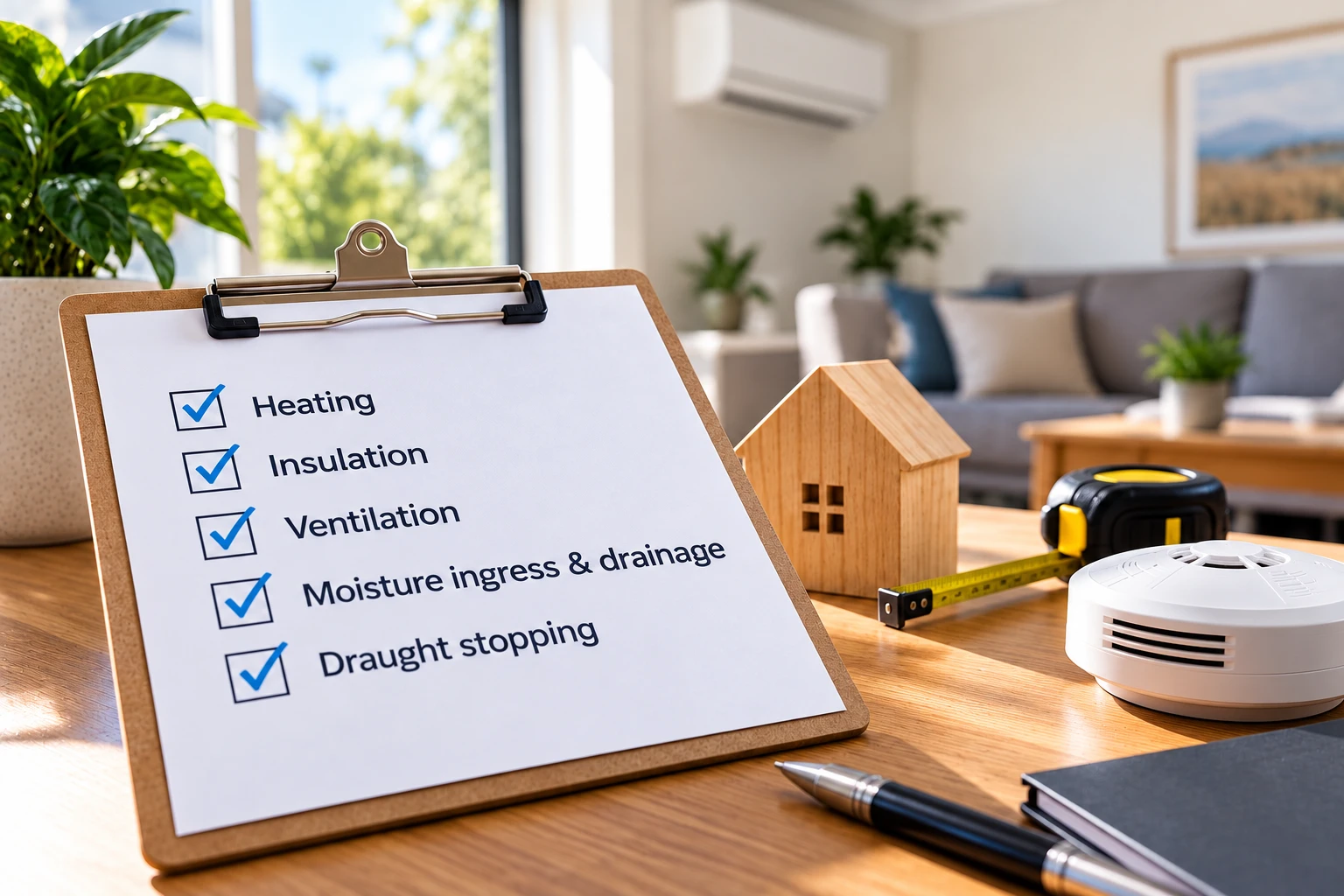
The Healthy Homes Standards set minimum requirements for rental properties in New Zealand, covering heating, insulation, ventilation, moisture and drainage, and draught stopping. Compliance is a legal requirement, not an optional extra.
The deadline for all rental homes to comply (1 July 2025) has now passed. For any rental you own, or are thinking of buying, the question is no longer when you will get to it. It is whether the property complies today, and whether you can show it.
The standards at a glance
Standard 1
Heating
A fixed heater in the main living area that can heat it to at least 18°C. Open fires, unflued gas heaters and portable heaters do not count.
Standard 2
Insulation
Ceiling and underfloor insulation to the required standard, unless an exemption applies.
Standard 3
Ventilation
Windows that open in living areas and bedrooms, plus extractor fans in kitchens and bathrooms that vent outside.
Standard 4
Moisture and drainage
Working gutters, downpipes and drains, plus a ground moisture barrier where there is an enclosed subfloor.
Standard 5
Draught stopping
No unreasonable gaps around doors, windows, floors and walls, and open fireplaces blocked off unless you and the tenant agree otherwise.
And the paperwork
Compliance statement
A signed compliance statement in new or renewed tenancy agreements, backed by records showing how you meet each standard.
The exact technical thresholds (heater sizing calculations, specific insulation ratings and so on) are detailed and worth getting properly assessed rather than estimated. Treat this as general orientation, not a compliance checklist to work from directly.
Recent changes. Two minor changes to the standards took effect on 25 September 2025. The exemption for ceiling insulation was reinstated, and the standards now take priority over some overlapping provisions in the older Housing Improvement Regulations 1947. If you are relying on an exemption, confirm with Tenancy Services or an assessor that it applies to your property before you do. The compliance statement requirement and penalties described below match Tenancy Services' guidance as updated in September 2026.
A closer look at the two that cost the most
Heating. Having a heat pump is not enough on its own. The heater has to be fixed, in the main living area, at least 1.5 kW, and large enough to bring that room up to 18°C. How big it needs to be depends on the size of the room, how well the home is insulated, and things like windows and ceiling height. Tenancy Services has a heating assessment tool that works this out, so you are not guessing. Heat pumps and electric heaters need a thermostat, and an electric heater (other than a heat pump) generally cannot be used where the room needs more than 2.4 kW.
Insulation. Ceilings and underfloor spaces need insulation that meets the standard. In Southland (climate zone 3), that means ceiling insulation of at least R3.3 and underfloor insulation of at least R1.3 for homes consented before November 2022, with newer homes following the Building Code. Older insulation can still count, but it has to be in reasonable condition with no mould, dampness, damage or gaps, so a home that was insulated years ago can still fall short. There are exemptions, for example where a professional installer cannot access or safely insulate the space, which is another reason an assessor is worth having.
Quick tip
Get a proper Healthy Homes assessment done before you list a property for rent, not after a tenant raises it or a complaint is made. It is far cheaper and less stressful to get ahead of it.
The things that most often catch landlords out
- Relying on a portable heater or an unflued gas heater as the main heating
- A heat pump that is too small for the living area it is meant to heat
- Old insulation that is compressed, damaged or has gaps
- Extractor fans that vent into the roof space instead of outside
- No ground moisture barrier under an enclosed subfloor
- Blocked or broken gutters, downpipes and drains
- An open fireplace that has not been blocked off
- Missing records, so compliance cannot be shown even where the work has been done
What you need to keep on file
Compliance is not just about the work. New or renewed tenancy agreements need a signed statement with details of the property's current level of compliance, and landlords must keep the records and documents that show how they comply, and make them available on request. That means quotes, invoices, assessment reports and photos, kept somewhere you can find them. If a tenant asks for compliance information, you have 21 days to provide it.
Not meeting the standards puts a landlord in breach of the Residential Tenancies Act, with financial penalties of up to $7,200. Leaving the compliance statement out of a tenancy agreement can mean a penalty of up to $500 for each tenancy.
Why it is worth taking seriously beyond compliance
A warm, dry, well-ventilated home is simply easier to keep tenanted, attracts a wider range of good tenants, and reduces the maintenance issues that come from damp and mould over time. It is one of those rare cases where the legal requirement and the sound business decision point the same direction.
Budgeting for the work
The usual areas of spend are heating, insulation top-ups, extractor fans, subfloor moisture barriers and drainage. Costs vary a great deal from one property to the next, so get more than one quote rather than relying on a rule of thumb. How the cost is treated for tax (a repair or a capital improvement) is a question for your accountant. For the wider picture of what to allow for, see what expenses should investors allow for.
If you are buying a rental
Healthy Homes status is part of your due diligence, and any shortfall is a cost you will inherit. Before you make an offer, it is worth asking:
- Has a Healthy Homes assessment been done, and can I see the report?
- What type and size is the main heater, and where is it?
- When was the insulation installed, and what is its condition?
- Do the kitchen and bathroom fans vent outside?
- Is there an enclosed subfloor, and if so, is there a ground moisture barrier?
- What does the compliance statement in the current tenancy agreement say?
If the answers show work is needed, factor the cost into your offer. It is a fair thing to negotiate on. For more on what to look for in an investment property, see what makes a good rental property.
If you are selling a tenanted property
Buyers, particularly investors, will ask about compliance. Having a recent assessment and your records ready makes the sale smoother and gives buyers confidence. It also takes a common point of negotiation off the table. There is more on this in selling a tenanted property.
Where to get the real answers
Tenancy Services (part of MBIE) publishes the official, current requirements at tenancy.govt.nz/healthy-homes, and a qualified Healthy Homes assessor can tell you exactly where a specific property stands. Both are more reliable than any general page, including this one.
If you are buying and want to understand what a property might need before you commit, I am happy to help you think it through.
This is general orientation only, not compliance advice. Confirm current Healthy Homes requirements with Tenancy Services or a qualified assessor.